749-second window · 3 observations · Measured Oct 10, 2026, 3:54 PM UTC · Provider: go_recent_snapshot_v2
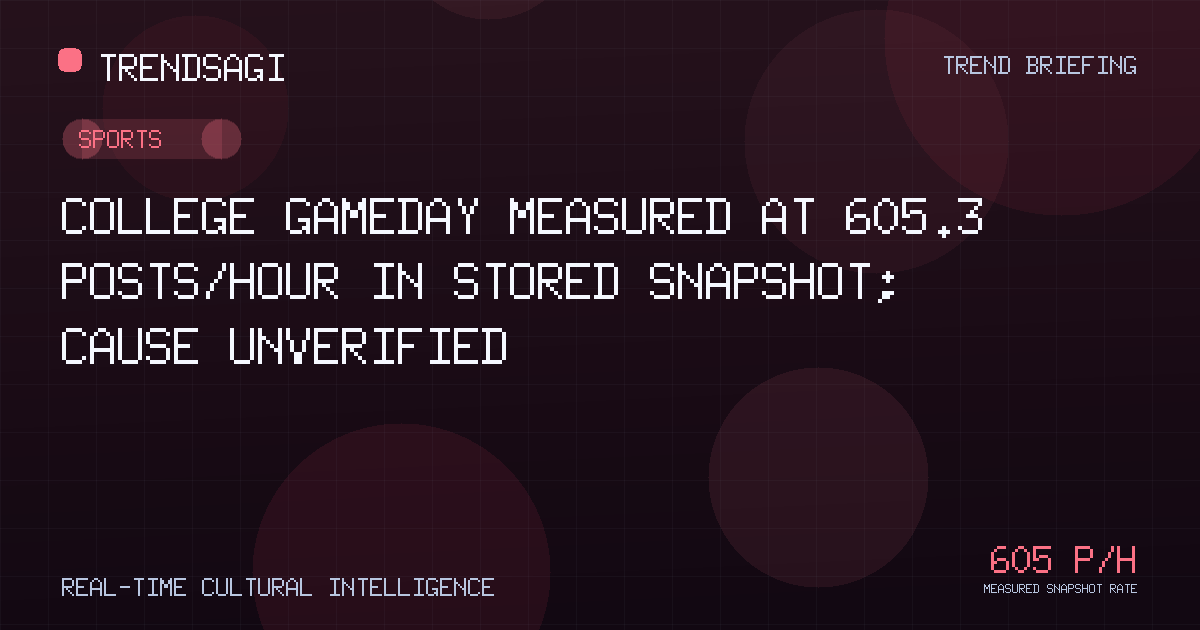
College Gameday measured at 605.3 posts/hour in stored snapshot; cause unverified
College Gameday measured 605.3 posts/hour over 749 seconds with 220 posts; the cause is unverified, so verify context before treating it as a live trend.
Automated briefing. Generated from stored signal measurements and source-backed research; it is not manually reviewed. Read the methodology and limitations.
Metrics in this briefing are a snapshot associated with its publication date and may not reflect current conditions.
What changed
College Gameday registered a measured snapshot rate of 605.3 posts/hour in the latest stored measurement, but the available record does not identify a verified catalyst. The defensible read is short-window posting activity that warrants verification, not a confirmed reaction to a game, announcement, controversy, or other public event.
The measured snapshot rate covers an exact 749-second window using 3 stored observations. The latest snapshot, timestamped 2026-10-10T15:54:55Z, contains 220 posts. With no earlier comparison supplied, the data do not establish an increase over normal, the magnitude of acceleration, persistence, or cause.
| Observation time | Measured snapshot rate | Latest snapshot volume |
|---|---|---|
| 2026-10-10T15:54:55Z | 605.3 posts/hour | 220 posts |
Why this topic may be moving
Verified answer: The cause is unclear. The stored category is Sports, but a category is not causal evidence, and the stored signal description contains no supporting context. No contemporaneous public report has been verified as the trigger for this measurement.
Possible explanations include a timed sporting event, a news development, a prominent post or video, promotional activity, or amplification across accounts. Those are hypotheses, not findings. A valid explanation would need public evidence or post-level references connecting the activity to a specific catalyst and aligning with the observation window.
- Content: Check whether a large share of posts points to one event, claim, clip, result, or announcement rather than merely sharing the label.
- Timing: Check whether post timestamps cluster around a publicly documented event, and whether that event predates the activity.
- Distribution: Check whether repeated text, reposting, or a small set of highly active accounts could explain the volume. The current aggregate does not distinguish those patterns.
The measurement quantifies post activity inside its window; it does not establish what caused the activity, who participated, or what the activity means.
Why it matters
The signal is most useful as a verification trigger. It tells editors and monitoring teams where to look, not what conclusion to publish.
- Sports editors: This measured snapshot rate can justify checking breaking coverage, game-related discussion, or a developing controversy before the topic disappears.
- Community teams: The next task is to review the posts themselves for context, repetition, sentiment, and moderation issues; none of those qualities is present in the aggregate.
- Audience researchers: The measurement should not be treated as a stable preference or forecast. A longer comparison using the same collection method is needed.
- Governance and brand-safety teams: A concentrated pattern may warrant review, but it does not by itself demonstrate automation, coordination, or harmful conduct.
The practical distinction is between a signal and a story. The measured 605.3 posts/hour figure can open an editorial check, while the 220-post snapshot can supply a sample to inspect. Neither number represents reach, engagement, sentiment, or unique people, and neither should be added together or treated as interchangeable.
What to watch next
Subsequent checks should try to convert the measurement into evidence rather than add more unsupported narrative.
- Collect another observation: Recheck the same signal series to see whether the measured snapshot rate persists, recedes, or changes after the recorded window.
- Verify public context: Use a targeted Google Search around 2026-10-10T15:54:55Z and exact-name variants. Attribute a catalyst only when a publisher's contemporaneous reporting supports it.
- Inspect the post sample: Review timestamps, wording, linked material, and account behavior. Determine whether posts converge on one subject or appear to be broad but low-information activity.
- Establish a baseline: Compare equivalent windows from the same source and collection rule. Without that comparison, describe 605.3 posts/hour as a measured snapshot rate, not proof of unusual growth.
- Measure breadth separately: Obtain distinct-account counts, geography, language, original-versus-reposted classifications, and sentiment. These measures answer different questions from raw post volume.
- Look for causal alignment: A credible event-driven explanation should have documented timing and independent public references. If those checks fail, retain cause unverified rather than promoting the most plausible story.
The concrete watch signal is not another vague mention of College Gameday. It is corroboration: later observations showing persistence, public reporting that names the relevant event, and posts whose content and timing match that account.
Methodology and limitations
The supplied 605.3 posts/hour figure is a measured snapshot rate based on 3 stored observations across an exact 749-second window. The 220 figure is latest snapshot volume. Posts are not people, and the supplied figures should not be read as a live count, forecast, reach estimate, engagement measure, audience total, or unique-person count.
The record does not specify the source platform, collection method, query coverage, geography, language, account deduplication, sentiment, prior baseline, or uncertainty. That limits interpretation in several ways: the sample may not represent the wider conversation, repeated posts may inflate apparent activity, and 3 observations over a short window may be sensitive to timing.
The topic name and Sports category are stored labels, not proof of the underlying subject. No verified public catalyst or post-level evidence is attached, so the signal can support monitoring and verification priorities but not causal attribution. The appropriate status remains: noteworthy measured snapshot activity, cause unresolved.
Track This Topic for New Signals
Set alerts for future velocity or sentiment changes around this topic.
Explore Tracking PlansAbout TrendsAGI research
TrendsAGI's automated research pipeline publishes dated signal snapshots, methodology notes, and practical workflows for teams evaluating cultural momentum. Read how signals are scoped, scored, and limited in our research methodology.