1940-second window · 3 observations · Measured Oct 11, 2026, 1:27 AM UTC · Provider: go_recent_snapshot_v2
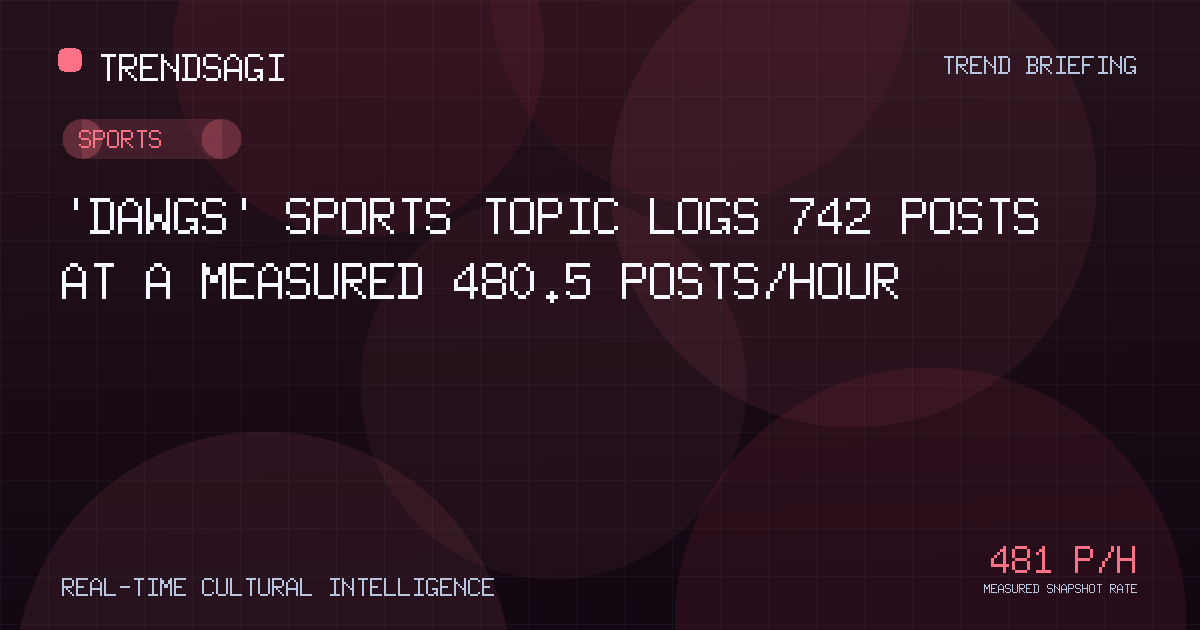
‘Dawgs’ sports topic logs 742 posts at a measured 480.5 posts/hour
The latest “Dawgs” snapshot has 742 posts and a measured 480.5 posts/hour, but its trigger, identity, and persistence remain unverified.
Automated briefing. Generated from stored signal measurements and source-backed research; it is not manually reviewed. Read the methodology and limitations.
Metrics in this briefing are a snapshot associated with its publication date and may not reflect current conditions.
What changed
The supported takeaway is narrow: the latest stored observation for the sports topic labeled “Dawgs” contains 742 posts. This confirms collected activity at that snapshot, but it does not by itself establish a breakout, sustained trend, or connection to a particular team, league, match, or news event. The topic identity itself remains unresolved.
Over an exact 1940-second window using 3 stored observations, the measured change rate was 480.5 posts/hour. This is a measured snapshot rate, not a live or current rate, forecast, reach figure, engagement count, or count of unique people. The rate shows posting velocity inside the measured window; it does not supply a reason for the activity.
| Observation time | Measured snapshot rate | Snapshot volume |
|---|---|---|
| 2026-10-11T01:27:03Z | 480.5 posts/hour | 742 posts |
What is established
The signal supports a verification alert, not a causal headline. It establishes that the collection recorded 742 posts at the stated observation time and that the supplied window calculation produced 480.5 posts/hour.
- Observed volume: 742 posts is the latest snapshot volume. It is not the posts/hour figure and should not be treated as an audience size.
- Measured velocity: 480.5 posts/hour summarizes the supplied 1940-second window. It cannot be carried forward as the rate now.
- Timing: The reading is anchored to 2026-10-11T01:27:03Z. Activity outside that observation period is not described by this snapshot.
- Missing comparison: With no supplied baseline, the data cannot show whether posting activity was accelerating, exceptional for this topic, or already fading.
Why this topic may be moving
The reason remains unclear because no verified public context in the supplied record connects the label to an event at the observation time. A game result, roster development, controversy, announcement, or scheduled sports event could be relevant, but none is established here. Any named trigger would go beyond the evidence.
- Event hypothesis: A time-sensitive sports development may have prompted immediate reaction.
- Identity hypothesis: “Dawgs” may refer to more than a particular team or community, so apparently related posts may not describe the same subject.
- Repetition hypothesis: Multiple posts may be quoting or copying a smaller number of original messages, increasing volume without adding independent discussion.
- Collection hypothesis: Query coverage, source mix, or collection timing may have changed and affected the count.
These are hypotheses to test, not findings. Without representative post text, source links, account context, or a verified public trigger, the signal cannot distinguish among them.
Why it matters
Social editors should treat the reading as a prompt to verify before publishing a trend claim or scheduling coverage around it. The combination of snapshot volume and measured velocity can prioritize checking, but rapid interpretation also raises the risk of attaching the activity to the wrong event.
A measured posting rate identifies where activity occurred in the sample; it does not identify the event, the participants, or their views.
Teams, leagues, creators, and community managers should care because an ambiguous label can fragment monitoring. If “Dawgs” covers multiple subjects, a response based only on aggregate volume could target the wrong audience or misstate consensus.
Analysts and readers should also keep the measures separate. Post count is not public opinion, sentiment, importance, or reach. Many formulaic or duplicate messages can produce measurable posting velocity while revealing little about what participants actually think.
What to watch next
The next useful evidence should resolve identity, cause, and persistence rather than merely add another headline:
- Resolve the label. Inspect a representative sample for exact-match terms, related hashtags, named entities, account bios, and source links. Confirm whether the posts point to a specific team, a player, a game, or a broader community.
- Check the trigger through Google Search. Look for public developments timestamped close to 2026-10-11T01:27:03Z. Compare publication and post times, including timezone, and seek an official or credible explanation before naming a cause.
- Test persistence. Compare later observations with earlier baselines using clearly defined windows. Watch whether both the measured rate and snapshot volume remain elevated; one isolated reading is not enough.
- Inspect message concentration. Count original posts separately from quotations, reposts, and duplicates where the available fields allow. Review whether discussion is concentrated around a small number of sources.
- Measure tone, not just volume. Code a sample for reaction, criticism, information, humor, or unrelated use of the label. This prevents high activity from being mislabeled as agreement or controversy.
- Audit collection effects. Check for query changes, duplicated URLs, automated posting patterns, and uneven source coverage. Treat bot activity as a possibility to test, not a conclusion.
Methodology and limitations
The rate is a measured snapshot rate supplied from 3 observations across an exact 1940-second window ending at 2026-10-11T01:27:03Z. The 742-post figure is the snapshot volume at that time. Neither number is a forecast, a live/current rate, reach, engagement, sentiment, or a unique-person count.
The record does not include underlying posts, source links, a longer time series, account counts, geography, language, collection settings, or verified public context. Those omissions limit conclusions about cause, audience, and durability. Sampling or classification changes could also alter observed activity. Accordingly, the evidence supports “activity was detected” and “verification is needed,” but not a confident explanation of why “Dawgs” was moving or whether it remained hot afterward.
Track This Topic for New Signals
Set alerts for future velocity or sentiment changes around this topic.
Explore Tracking PlansAbout TrendsAGI research
TrendsAGI's automated research pipeline publishes dated signal snapshots, methodology notes, and practical workflows for teams evaluating cultural momentum. Read how signals are scoped, scored, and limited in our research methodology.