896-second window · 3 observations · Measured Oct 10, 2026, 6:57 PM UTC · Provider: go_recent_snapshot_v2
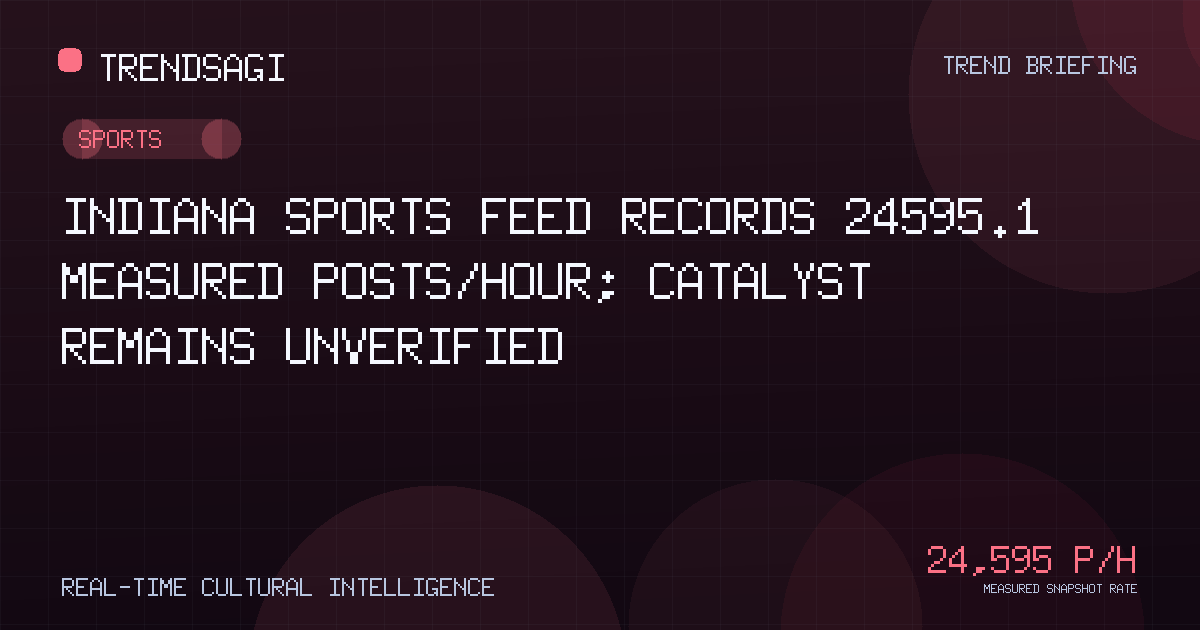
Indiana sports feed records 24595.1 measured posts/hour; catalyst remains unverified
Indiana's sports feed recorded 24595.1 measured posts/hour and a 9000-post snapshot; the trigger is unverified, with practical checks for editors.
Automated briefing. Generated from stored signal measurements and source-backed research; it is not manually reviewed. Read the methodology and limitations.
Metrics in this briefing are a snapshot associated with its publication date and may not reflect current conditions.
What changed
The monitored “Indiana” topic recorded a measured change rate of 24595.1 posts/hour in the Sports category, but the available record does not identify the event or issue driving the activity. This is a high-priority signal for editors and monitors to investigate, not confirmation that a particular Indiana sports story has gone viral.
The rate was measured at 2026-10-10T18:57:36Z across an exact 896-second window using 3 observations. The latest snapshot contained 9000 posts. Posts/hour is a measured snapshot rate rather than a live count, forecast, total audience, engagement measure, or unique-person count; snapshot volume should not be described as a rate.
| Observation time | Measured posts/hour | Latest snapshot volume |
|---|---|---|
| 2026-10-10T18:57:36Z | 24595.1 | 9000 posts |
Why this topic may be moving
“Indiana” is a broad label, and the signal has no accompanying description identifying a specific team, athlete, competition, organization, or news event. That ambiguity creates several plausible explanations that should be tested rather than presented as established facts.
- Event-led clustering: Activity may be concentrating around a game result, roster change, injury, award, schedule announcement, or another sports development. The signal does not show which, if any, is responsible.
- Entity overlap: Posts using “Indiana” may refer to different teams, programs, players, places, or broader state-related conversations that the topic label has combined.
- News-cycle spillover: A breaking sports story could have introduced the location term into posts even when those posts are not all about the same underlying event.
- Duplication or automated activity: Repeated copies, coordinated posting, or a feed artifact could increase volume without representing a comparably broad human conversation.
- Classification mismatch: The stored category is Sports, but individual posts may still have been grouped incorrectly or may discuss sports only incidentally.
No verified public event or report could be tied to the observation timestamp from the available context. The cause therefore remains unclear. Naming a specific catalyst without confirming the entities, timing, and subject matter of the contributing posts would turn a measurable activity spike into an unsupported story.
The defensible conclusion is not that Indiana broke because of a particular event, but that the monitored feed changed rapidly at this timestamp and requires validation before a cause is assigned.
What the signal can and cannot establish
The signal is useful as an alert because it provides three concrete observations:
- A measured change rate of 24595.1 posts/hour for the specified 896-second window.
- A latest snapshot volume of 9000 posts under the Sports category.
It does not establish the following:
- Whether 24595.1 posts/hour is high relative to Indiana’s normal baseline.
- Whether the rate persisted after the observation or will persist now.
- Which event, entity, or issue generated the posts.
- How many distinct accounts or people participated.
- Whether the activity was organic, duplicated, automated, or geographically representative.
- Whether readers were positive, negative, neutral, or engaged beyond posting.
- Whether the Sports category and Indiana label accurately describe every included post.
Why it matters
For sports and local-news editors, the immediate value is triage. The rate is large enough to justify checking the underlying posts before publishing a causal explanation, headline, or roundup. The first reporting task is not to amplify the topic but to determine whether the posts share a concrete subject.
Communication teams, event monitors, and community organizations should also avoid treating the label as a reliable stakeholder count. A large post volume can arise from repetition or a narrow cluster, while genuine public attention may produce fewer posts across more distinct accounts.
Trend analysts should preserve the distinction between conversation activity and audience impact. The 9000-post snapshot shows the scale of material in that observation, while 24595.1 posts/hour shows how quickly the measured feed changed. Neither figure demonstrates reach, importance, sentiment, or public impact on its own.
What to watch next
- Identify the dominant subject: Review the posts contributing most heavily to the snapshot and group them by named entities, event terms, and links. A large cluster around one verifiable development would support a specific explanation.
- Check account and content diversity: Determine whether activity comes from many distinct accounts or repeated copies of a small number of posts. Compare account diversity with content diversity rather than assuming both are high.
- Test for duplication: Look for near-identical wording, repeated URLs, synchronized posting, and low-information reaction posts. This helps separate genuine conversation volume from mechanical amplification.
- Compare adjacent windows: Place the 24595.1 posts/hour measurement beside comparable historical and immediately subsequent windows. Without that baseline, the signal cannot show whether the burst is exceptional or part of ordinary volatility.
- Verify timing and causality: Any proposed catalyst should have a public timestamp that precedes or aligns with the rise. Credible reporting or an official event record should directly match the entities appearing in the posts.
- Watch for sharper classification: A follow-up signal that identifies a specific team, competition, player, or event would be more useful than continued reliance on the broad Indiana label.
Concrete confirmation would include subsequent measured windows remaining near or above 24595.1 posts/hour, sustained activity across distinct accounts, and multiple credible references converging on the same event. Continued volume without thematic convergence would instead point toward label ambiguity, duplication, or a broader feed effect rather than a single verified trend.
Methodology and limitations
The reported rate is a measured snapshot rate calculated over an exact 896-second window from 3 observations at 2026-10-10T18:57:36Z. The separate 9000-post value represents latest snapshot volume and is not a rate. The category is Sports, while no topic description or verified public catalyst is available.
Because the signal lacks historical baselines, account-level evidence, deduplication results, sentiment measures, and event-level verification, it can identify where attention should be directed but cannot establish why attention occurred. Any update should preserve the timestamp and measured figures while adding independently verified context.
Track This Topic for New Signals
Set alerts for future velocity or sentiment changes around this topic.
Explore Tracking PlansAbout TrendsAGI research
TrendsAGI's automated research pipeline publishes dated signal snapshots, methodology notes, and practical workflows for teams evaluating cultural momentum. Read how signals are scoped, scored, and limited in our research methodology.