901-second window · 3 observations · Measured Oct 10, 2026, 11:57 PM UTC · Provider: go_recent_snapshot_v2
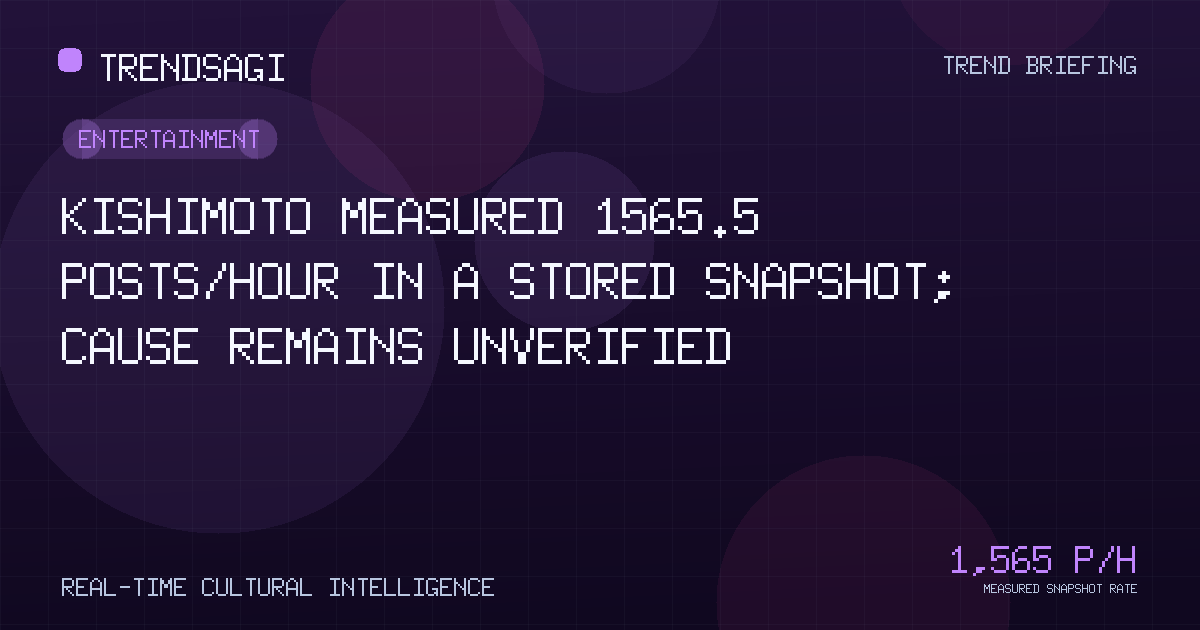
Kishimoto measured 1565.5 posts/hour in a stored snapshot; cause remains unverified
Kishimoto shows a measured snapshot rate of 1565.5 posts/hour; the cause is unverified, with practical checks for assessing the spike.
Automated briefing. Generated from stored signal measurements and source-backed research; it is not manually reviewed. Read the methodology and limitations.
Metrics in this briefing are a snapshot associated with its publication date and may not reflect current conditions.
What changed
The stored record supports one clear conclusion: the label “Kishimoto” generated a measured burst of posting activity, but no cause can be verified. The record supplies no announcement, release, interview, controversy, or other event, and it includes no verified public source that ties the activity to a specific development. The defensible framing is an unexplained posting spike, not confirmation of breaking entertainment news.
The measured snapshot rate was 1565.5 posts/hour, based on 3 stored observations across an exact 901-second window and measured at 2026-10-10T23:57:29Z. The latest stored snapshot contained 1142 posts. These are distinct measures: the rate summarizes posting velocity within the stored window, while the volume counts posts in the snapshot. Neither figure should be read as a live or current rate, forecast, reach, engagement, or unique-person count.
| Observation time | 2026-10-10T23:57:29Z |
|---|---|
| Measured snapshot rate | 1565.5 posts/hour |
| Latest snapshot volume | 1142 posts |
Why this topic may be moving
No catalyst is verified in the available record. The stored category, “Entertainment,” provides a classification but does not identify an event. The one-word label also does not establish which person, work, project, announcement, or incident is responsible. Without post text or a verified external item, assigning a cause would be speculation.
Possible mechanisms to test—not findings to report—include:
- A verified entertainment update connected to someone or something identified as Kishimoto.
- Secondary coverage, search discovery, or platform recirculation turning a smaller item into a wider posting burst.
- Audience reaction to an interview, release, appearance, storyline, or controversy, none of which can be confirmed here.
- Repeated quotations, reposts, or automated posting inflating activity without equivalent original discussion.
A measured posting spike establishes observed velocity, not the event that caused it. The missing link is a verified catalyst and a credible alignment between that catalyst and the observed posts.
What the signal can and cannot establish
The useful evidence is limited to posting quantity and timing at the label level.
- It establishes the measured snapshot rate, observation window, observation count, and snapshot volume recorded at the stated time.
- It does not establish which Kishimoto the label denotes or whether different meanings were combined in the count.
- It does not distinguish original posts from copies, quotations, replies, or automated activity.
- It cannot translate post volume into unique participants, audience size, or broad public interest.
- It provides no direct evidence of sentiment, opinion, credibility, geography, or the substance of the discussion.
Why it matters
A high measured posting rate can trigger coverage decisions, search checks, and source requests, but the unresolved identity and cause create an amplification risk. Editors could mistakenly turn an ambiguous label into a specific news claim, while audience and reputation teams could respond to activity that has not yet been explained.
The appropriate response is verification before amplification. Readers should not treat the rate as evidence that a particular event happened, and decision-makers should wait for a credible public source and a time-aligned sample of relevant posts before describing the signal as event-driven.
What to watch next
- Disambiguate the label. Use a Google search for the exact term, adding the observation date and any co-occurring names or works. Treat results as identification candidates until the underlying pages establish the match.
- Locate a first-party catalyst. Check whether a verified official channel or primary source has a relevant announcement, interview, release, appearance, or correction. A matching timestamp would be stronger evidence than a later reaction post.
- Establish chronology. Identify the earliest substantive item connected to the label, then compare its timing with the measured window. Later discussion should not be mistaken for the original trigger.
- Inspect post composition. Determine whether the count is dominated by original posts, replies, quotations, or repeated reposts of one item. The supplied rate cannot answer that question.
- Test persistence. Collect additional stored snapshots and compare their rate and volume with this observation. A one-window spike and sustained activity support different editorial conclusions.
- Seek independent corroboration. See whether credible publishers describe the same development and connect their reporting to the same trigger. Attribute a cause only to a source that actually verifies it.
A practical editorial rule is straightforward: call the movement event-driven only when a credible catalyst, relevant post sample, and compatible timing all align. If those elements remain absent, report it as an unexplained rise in Kishimoto-related posts.
Methodology and limitations
This briefing uses the exact stored observation time of 2026-10-10T23:57:29Z, the measured snapshot rate of 1565.5 posts/hour, the exact 901-second window, the 3 stored observations, and the latest snapshot volume of 1142 posts. The snapshot rate is a historical measured value, not a present-day measurement. No comparison baseline was supplied, so it does not establish a percentage increase, acceleration, or difference from normal activity.
No verified external cause accompanies the signal, and the stored description contains no supporting detail. The Entertainment category is taxonomy, not corroboration. The data also does not expose account identities, unique users, engagement, sentiment, source quality, geographic distribution, or organic versus automated behavior. Consequently, the defensible finding is limited to a measured posting spike whose subject, driver, and duration remain unresolved.
Track This Topic for New Signals
Set alerts for future velocity or sentiment changes around this topic.
Explore Tracking PlansAbout TrendsAGI research
TrendsAGI's automated research pipeline publishes dated signal snapshots, methodology notes, and practical workflows for teams evaluating cultural momentum. Read how signals are scoped, scored, and limited in our research methodology.