907-second window · 3 observations · Measured Oct 10, 2026, 5:58 PM UTC · Provider: go_recent_snapshot_v2
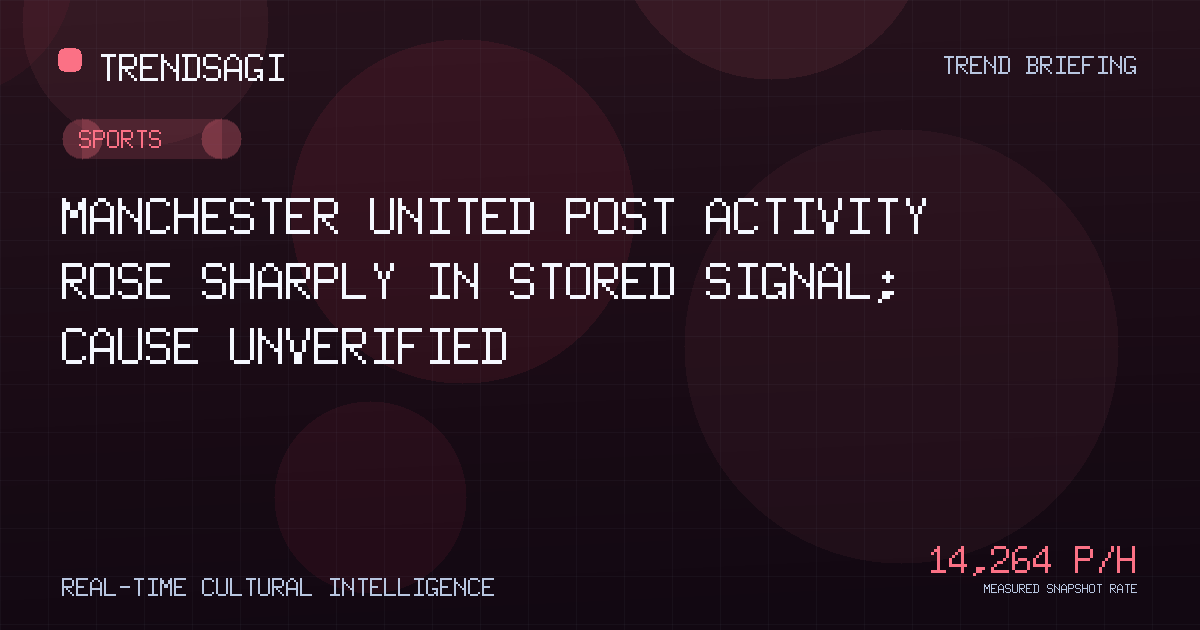
Manchester United post activity rose sharply in stored signal; cause unverified
Manchester United post activity rose to a measured 14263.8 posts/hour; here is what the spike shows, what it cannot prove, and what to check next.
Automated briefing. Generated from stored signal measurements and source-backed research; it is not manually reviewed. Read the methodology and limitations.
Metrics in this briefing are a snapshot associated with its publication date and may not reflect current conditions.
What changed
Manchester United has a sharp measured rise in post activity, but the available record does not establish why. This is a fast-moving topic worth monitoring, not yet a verified news event: the signal cannot by itself show that a fixture, transfer, personnel decision or club announcement caused the movement.
The measured snapshot rate was 14263.8 posts/hour over an exact 907-second window using 3 stored observations, ending at 2026-10-10T17:58:07Z. The latest snapshot volume was 5538 posts. Those figures answer different questions: 5538 describes the latest snapshot, while 14263.8 posts/hour describes measured movement across the window. The rate is not a live or current rate, forecast, reach, engagement figure or unique-person count.
| Observation time | Measured snapshot rate | Latest snapshot volume |
|---|---|---|
| 2026-10-10T17:58:07Z | 14263.8 posts/hour | 5538 posts |
The change is large enough to trigger verification and faster monitoring. It is not enough to explain the spike. The record provides no ordinary baseline, the individual observation counts or a longer history, so it cannot show whether this is normal for Manchester United coverage, how long the burst lasted, or whether activity would persist.
The rate and volume should also remain separate. A posts/hour measure can summarize activity observed during a window even when a single snapshot contains fewer posts; the supplied values do not reveal the calculation path or a common denominator. They should not be substituted for one another.
Why this topic may be moving
The only explicit context is that the stored category is Sports; the signal description is empty. No verified public catalyst accompanies the record. The responsible conclusion is therefore straightforward: why this topic may be moving remains unclear.
Possible explanations include a live match or result, lineup news, a transfer report, a club or management update, or a wave of supporter reaction. Those are hypotheses only, not findings. A high-volume topic can also be amplified by repetition, automated posting, a scheduled conversation or several stories competing for attention. Raw volume does not distinguish among them.
Nor does the signal show what the posts said. A spike driven by criticism and one driven by supportive discussion would look identical in this record. Without verified timing and representative content, assigning a cause—or a consensus reaction—would go beyond the evidence.
A measured posting spike can establish that a topic became more active in the sampled window. It cannot, by itself, establish what happened, who reacted, or whether the reaction was favorable.
Why it matters
The immediate value is triage. It tells editors and monitoring teams where to look first, and it gives communications, sponsorship and sports-intelligence teams a reason to check whether the burst is sustained. It does not tell them that the underlying event is more important than another story.
- For editors and publishers: Verify the catalyst before turning the spike into a causal headline. A monitored increase is evidence of activity, not evidence of what prompted it.
- For club or brand teams: Treat the number as an early warning. It is not a measure of audience size, favorable sentiment, earned reach or commercial effect.
- For analysts: Preserve the query, collection window and filters. Without them, a later spike cannot be compared confidently with this observation.
- For readers: Do not read 5538 posts as 5538 people, nor 14263.8 posts/hour as a forecast. Repetition and multiple posts from one account are not ruled out.
Who should care most is anyone making a time-sensitive decision from conversation data: newsrooms, communications leads, sponsors and researchers. The correct response is to verify and compare, not to announce a conclusion from volume alone.
What to watch next
The next checks should be designed to disprove an easy explanation, not merely add more posts to the summary.
- Establish timing. Check whether a verifiable official update, match event or established report appeared before the spike. Record publication time and the first concentrated reaction; a story published afterward cannot explain the earlier activity.
- Test persistence. Compare the next equal 907-second windows using the same topic definition and collection rules. Keep the measured snapshot rate and snapshot volume as separate fields; do not infer a live rate from this endpoint.
- Inspect composition. Sample the earliest and densest periods, remove obvious duplicates where possible, and group posts by language, geography, account type and story. Look for whether discussion converges on one claim or many unrelated claims.
- Verify quality. Distinguish original reactions from copies, automated patterns and promotional or oppositional repetition. A large post count driven by duplicated material has a different meaning from broad independent discussion, even though the raw totals match.
- Check context. Use official Manchester United material, relevant governing or competition material, and established reporting to confirm or reject each candidate catalyst. Leave the cause open if timing and content do not align.
Concrete watch signals are straightforward:
- Another measured snapshot rate near or above 14263.8 posts/hour would indicate persistence, not merely the endpoint already observed.
- Snapshot volumes remaining above the latest 5538-post benchmark would provide a second, separate sign of sustained activity.
- A dense cluster of posts linking to one newly verified event would strengthen a causal explanation.
- Rapid normalization in the next equal window would instead support a short-lived burst.
- Heavy duplication, narrow account patterns or failure to find a matching public event would weaken the claim that broad news demand drove the movement.
Methodology and limitations
The signal consists of 3 stored observations across an exact 907-second window ending at 2026-10-10T17:58:07Z, with a measured snapshot rate of 14263.8 posts/hour and latest snapshot volume of 5538 posts. The timestamp marks the observation endpoint, not the time of any underlying event.
No baseline, query definition, individual observation counts, geographic coverage, language mix, deduplication method, account classification or representative text sample is supplied. Those omissions prevent conclusions about unique users, organic reach, sentiment, causation or statistical significance. The result is reliable only as a description of the stored monitoring signal.
For that reason, this briefing reports the supplied measurement but no verified catalyst. The next update should be judged by whether it adds a confirmed cause and comparable observations, not by repeating the same activity number with stronger language.
Track This Topic for New Signals
Set alerts for future velocity or sentiment changes around this topic.
Explore Tracking PlansAbout TrendsAGI research
TrendsAGI's automated research pipeline publishes dated signal snapshots, methodology notes, and practical workflows for teams evaluating cultural momentum. Read how signals are scoped, scored, and limited in our research methodology.