894-second window · 3 observations · Measured Oct 10, 2026, 11:42 PM UTC · Provider: go_recent_snapshot_v2
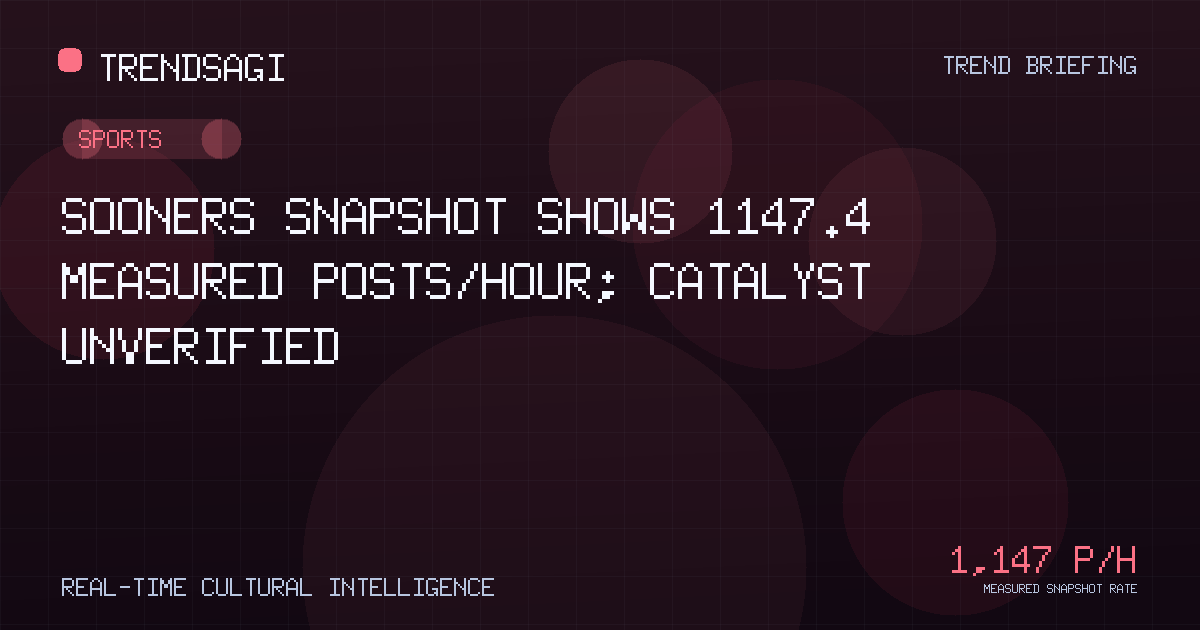
Sooners snapshot shows 1147.4 measured posts/hour; catalyst unverified
The “Sooners” snapshot registered 1147.4 posts/hour and contained 1220 posts; the signal flags a spike, but its catalyst remains unverified.
Automated briefing. Generated from stored signal measurements and source-backed research; it is not manually reviewed. Read the methodology and limitations.
Metrics in this briefing are a snapshot associated with its publication date and may not reflect current conditions.
What changed
The “Sooners” topic registered a sharp short-window rise in the stored sports-post stream, but the available record does not establish what triggered it. The latest observation, at 2026-10-10T23:42:13Z, contained 1220 posts. That figure is a snapshot volume, not a posting rate, audience size, or measure of engagement.
The measured change was 1147.4 posts/hour, measured across an exact 894-second window using 3 stored observations. It should be read only as a measured snapshot rate for that interval—not as a live/current rate, forecast, reach, engagement, or unique-person count. No external catalyst has been verified, so the movement should not yet be attributed to a game, announcement, controversy, or other event.
| Observation | Observation time | Measured snapshot rate | Snapshot volume |
|---|---|---|---|
| Latest stored observation | 2026-10-10T23:42:13Z | 1147.4 posts/hour | 1220 posts |
Why this topic may be moving
No public catalyst has been verified for this briefing, so it would be premature to say that a match, result, announcement, controversy, or fan reaction caused the movement. The record establishes a change in the sampled topic stream, not the event behind it. The stored Sports classification is useful context, but it does not identify an entity or verify a cause.
The main unresolved issue is entity resolution. A topic label can collect conversation about a team, a player, a game, or an unrelated use of the same words; a spike can also be driven by a headline, a clip, repeated reposting, or automated posting. These are hypotheses to test, not findings. Without matched examples from the 3 observations, none can be preferred responsibly.
A measured rate shows that the sampled stream changed quickly; it does not establish what happened, who participated, or whether the activity was organic.
A defensible explanation would need dated public evidence connecting the same entity and event to the observed window. A publisher report or official event record could establish context, while the underlying posts would show how the label was actually used. Until both sides line up, the useful conclusion is narrow: the label moved sharply, and its cause remains unclear.
Why it matters
This signal matters because short-window velocity can help an editor decide what deserves immediate review. Together, 1220 posts in the latest snapshot and a 1147.4 measured posts/hour document the size and short-window movement of the captured sample. They do not show how many people were involved, whether any post was seen, or whether sentiment was positive, negative, or neutral.
- For a newsroom or sports desk, treat the spike as a verification lead, not evidence of a breaking event. Identify the subject and find a dated public explanation before using it to explain the movement.
- For a fan community or team operations group, inspect the sampled posts before escalating the label internally. Apparent activity may reflect repetition, a clip, or conversation about something other than the presumed subject.
- For an analyst, preserve this as an anomaly to test against the same source coverage and cadence rather than treating one burst as a durable trend.
What to watch next
The next useful step is not to extrapolate the spike but to resolve it. Five checks offer the clearest path forward:
- Inspect all 3 observations. Compare exact post times and source records to locate the first appearance of the label and determine how much activity is genuinely new rather than repeated.
- Resolve the entity. Check whether the posts refer to the same team, person, or event. Do not collapse different subjects under “Sooners” until examples support that mapping.
- Separate original content from copies. Repeated wording, media, quote-post chains, and synchronized bursts can amplify apparent activity; quantify them only after inspection.
- Verify a catalyst. Look for a dated report from an established publisher or a matching official record that aligns with the label, entity, and observation window. Attribute any external explanation to its publisher before publication.
- Compare like with like. Evaluate complete windows of the same 894-second length under unchanged collection rules. A longer baseline would help distinguish a repeatable pattern from a brief burst.
Concrete follow-up signals: Watch for persistence in the next complete 894-second window; a verifiable event match from a dated public source; original posts and independent discussion converging on one entity; a label change to something more specific; and divergence between snapshot volume and measured rate. If volume falls while the measured rate remains elevated, the burst may be cooling without reversing.
Methodology and limitations
The supplied rate is 1147.4 posts/hour, measured over the exact 894-second window from 3 stored observations, with the latest snapshot at 2026-10-10T23:42:13Z containing 1220 posts. These values answer different questions: the rate captures short-window movement, while volume captures the size of the latest stored sample. Neither is a live/current rate, forecast, reach, engagement, or unique-person count.
The record does not specify platform coverage, collection boundaries, deduplication, geography, language, account counts, sentiment, or the baseline used to judge magnitude. It also does not provide enough post-level context to determine whether the label maps cleanly to one subject. The 3 observations establish what was measured during the stated window but do not establish persistence beyond it.
No causal explanation is included because none could be verified. Treating “Sooners” as shorthand for a particular sports organization, game, or controversy would exceed the record. The sound editorial action is to flag the topic for verification and wait for a matched public event and representative post sample.
Track This Topic for New Signals
Set alerts for future velocity or sentiment changes around this topic.
Explore Tracking PlansAbout TrendsAGI research
TrendsAGI's automated research pipeline publishes dated signal snapshots, methodology notes, and practical workflows for teams evaluating cultural momentum. Read how signals are scoped, scored, and limited in our research methodology.