893-second window · 3 observations · Measured Oct 10, 2026, 5:43 PM UTC · Provider: go_recent_snapshot_v2
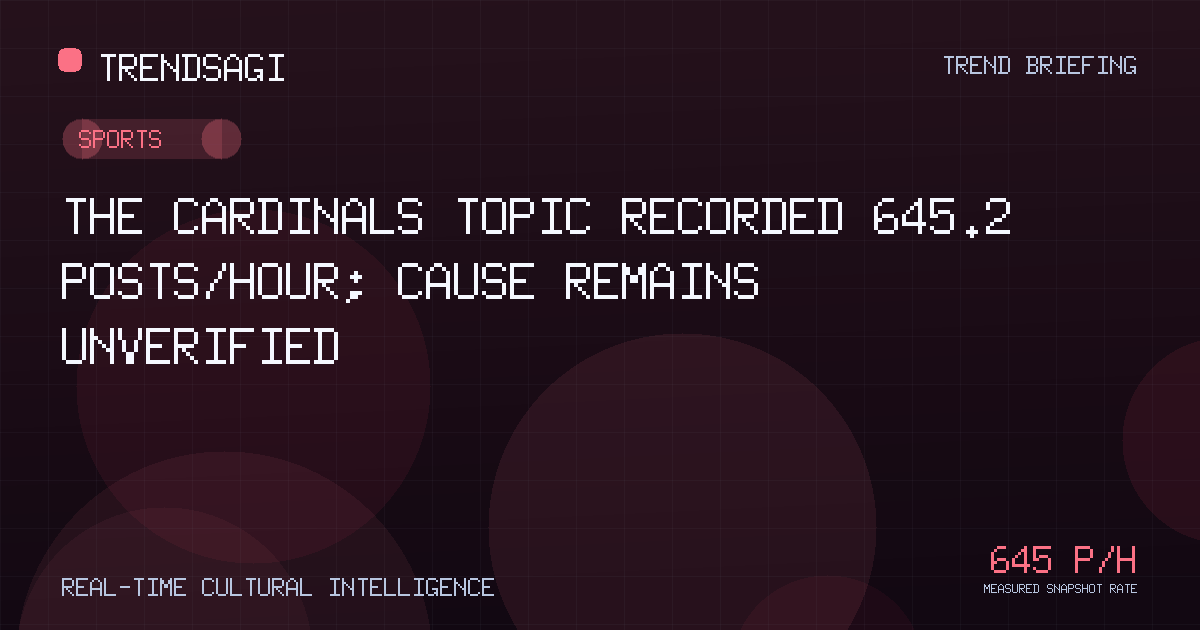
The Cardinals topic recorded 645.2 posts/hour; cause remains unverified
The Cardinals topic recorded a measured snapshot rate of 645.2 posts/hour; its cause remains unverified and the ambiguous label limits interpretation.
Automated briefing. Generated from stored signal measurements and source-backed research; it is not manually reviewed. Read the methodology and limitations.
Metrics in this briefing are a snapshot associated with its publication date and may not reflect current conditions.
What changed
The direct read is that “The Cardinals” registered a measured snapshot rate of 645.2 posts/hour in the latest stored window, but the reason for the movement is not verified. The topic label does not identify a particular team, person, organization, or event, so the activity should not yet be attributed to any specific Cardinals entity.
That measured change rate comes from an exact 893-second window using 3 stored observations, with the snapshot observed at 2026-10-10T17:43:07Z. The latest snapshot volume is 571 posts. These are separate measures: 645.2 posts/hour describes the measured snapshot rate for the stated window, while 571 posts is the volume in the latest snapshot. The record provides no earlier baseline showing that the rate rose, fell, or reached a typical level.
| Observation time | Measured posts/hour | Snapshot volume |
|---|---|---|
| 2026-10-10T17:43:07Z | 645.2 posts/hour | 571 posts |
Why this topic may be moving
No verified public explanation can be attached to this activity. “The Cardinals” is a broad phrase that could route readers toward different subjects, and a label collision is a possibility to test rather than a conclusion to assume. Other possible drivers include a scheduled sports event, a result, a personnel decision, a controversy, or renewed discussion of an older story. None of those possibilities is established by the stored figures alone.
Useful public context would need to do more than mention the same phrase. It would need to identify the entity being discussed, align with the observation window, and connect plausibly to the onset of tracked posts. Because no verified event or publisher account can be tied to the signal here, assigning a cause would add specificity that the evidence does not support.
The defensible conclusion is not that a particular Cardinals story caused a surge, but that posts carrying an ambiguous label appeared at a measured rate within a short observation window. The subject, driver, and broader significance still require verification.
What the signal can establish
The numerical record supports a narrow but useful conclusion about posting activity.
- Activity was recorded: The tracked topic produced 645.2 posts/hour during the exact 893-second measurement window.
- The sampled collection was substantial: The latest snapshot contained 571 posts, providing material for an entity and topic audit.
- Verification is warranted: The rate makes this a reasonable priority for editors, analysts, and organizations that may be named by the label.
- A causal story is not established: The record does not show whether the activity concerned a game, announcement, controversy, unrelated use of the phrase, or another subject.
The rate also does not reveal who posted, whether the accounts are unique, or how many posts were original. Copies, quotations, automated reposts, and multiple accounts can affect a post-count measure without representing equivalent public interest. The supplied information does not provide enough collection detail to reconcile the 645.2 posts/hour measurement with the separate 571-post snapshot volume.
Why it matters
Sports editors should avoid turning an ambiguous label into a specific event headline before checking the underlying posts. A collection about a team can be misread as a reaction to a result, while posts about a different organization can be combined under the same label. Either error could produce an accurate-looking narrative with the wrong subject.
Fan communities, team organizations, and communications teams should treat the signal as an early verification prompt, not evidence of reputational impact. Analysts and researchers should preserve the distinction between volume and rate, inspect duplication, and determine whether activity represents sustained discussion or a short cluster. Readers should not infer the cause, sentiment, reach, or importance of the topic from the headline label alone.
What to watch next
The next useful step is not another summary of the same rate. It is a sequence of checks that can resolve the entity and test the proposed trigger.
- Resolve the entity: Review a representative sample for team, league, location, player, staff, or institutional references. Separate competing uses rather than combining them under “The Cardinals.”
- Build the chronology: Examine when the earliest posts appeared and whether activity clusters around a game, result, announcement, or controversy.
- Verify a trigger: Check relevant official material and independently published reporting, then compare their timestamps with the tracked activity. Later coverage of an earlier event is not automatically its cause.
- Audit post quality: Distinguish original posts from quotations, reposts, likely duplicates, and automated activity. This shows whether independent participation is broader than the raw count suggests.
- Test persistence: Compare subsequent stored observations with the same measurement method. A continuing rate would support sustained discussion, while a sharp drop after this window would favor a short-lived cluster.
- Check convergence: Look for geography, source, and subject alignment. Credible cause attribution becomes stronger when the same specific event appears across independent posts and verified reporting.
Concrete watch signals are explicit references to a resolved entity, timing that precedes or closely aligns with a verified event, independent confirmation of that event, and subsequent measurements that remain active against a defined baseline. Until those signals emerge, the topic is best described as unresolved.
Methodology and limitations
This briefing uses the supplied stored measurement: 3 observations across an exact 893-second window, measured at 2026-10-10T17:43:07Z, producing 645.2 posts/hour alongside a latest snapshot volume of 571 posts. No verified public context was available to establish why the topic was moving, so the cause remains unclassified.
The 645.2 posts/hour figure is a measured snapshot rate, not a live or current rate, forecast, reach measure, engagement metric, or unique-person count. The 571-post figure is snapshot volume, not a rate. The window is exact but brief, and the record supplies no earlier baseline, sampling frame, collection method, sentiment, geography, or source distribution. It therefore establishes observed posting activity but not the event behind it, whether activity was sustained, or whether it represented broad public attention.
Track This Topic for New Signals
Set alerts for future velocity or sentiment changes around this topic.
Explore Tracking PlansAbout TrendsAGI research
TrendsAGI's automated research pipeline publishes dated signal snapshots, methodology notes, and practical workflows for teams evaluating cultural momentum. Read how signals are scoped, scored, and limited in our research methodology.